
Buying a new pitching machine is by no means a small investment. If you go with an automatic model that has two or three wheels, it will easily set you back a couple thousand dollars. Even a throwing arm-style pitching machine can get pricey depending on the model you’re after.
Amidst all of these pitching machines that cost upwards of a thousand dollars, going with an automatic machine doesn’t seem like the wisest idea for most youth and rec-league budgets.
But if you don’t mind a manual pitching machine, there’s one I always recommend: the Louisville Slugger Black Flame UPM50. If you’ve never heard of this machine before, you’re in for a treat.
In this Louisville Slugger Black Flame pitching machine review, I’ll put it under a looking glass and walk through its key features along with my own hands-on experience using it. I’ve also double-checked that it’s still sold in 2026 (it is, both directly through Louisville Slugger’s training gear site and at major retailers), so you don’t have to worry about chasing down a discontinued model. By the end of the article, you’ll have everything you need to decide whether it’s a worthwhile investment for you and your team.
First Impressions
On paper, the Louisville Slugger Black Flame doesn’t look all that exciting. It has a minimum velocity of 18 miles per hour and tops out around 50 miles per hour with regulation baseballs. At that range, it’s mostly suited for little leaguers and players who are just taking their first steps in the sport.
However, the way I use it, I find it’s worth a lot more than what I paid for it. The speed and accuracy are reliable, and while the power seems modest on paper, it’s still faster than most other sub-$300 pitching machines out there.
It’s also quite portable despite having a sturdy frame. Yes, it’s a manual machine, and yes, you need an operator whenever you want to use it, but considering the performance it gives for the price, I’d pick it up again in a heartbeat.
Louisville Slugger Black Flame Pitching Machine Review (Main Features)
Here are the key features of the Black Flame pitching machine, model UPM50, by Louisville Slugger:
1. Pitching Speed
The pitching speed the Black Flame offers isn’t exceptional, but it’s still pretty decent considering the price. I mostly use it to train youngsters, and to me it’s one of the top-rated little league pitching machines out there. Its speed range is perfect for honing the hitting and fielding technique of young athletes.
The velocity range runs from 18 miles per hour up to 50, which is a step up from the Louisville Slugger Blue Flame UPM45. So you can train your batters on both hitting slow balls and fastballs, though you won’t get curveballs out of it. It’s also approved for Babe Ruth League and Pony Baseball/Softball play, which the Blue Flame isn’t.
If you switch to lighter training balls, it can pitch faster, hitting somewhere in the 60 to 70 mile-per-hour range. I mostly use lite balls when I’m trying to improve a player’s reflexes or work on target tracking and depth perception.
2. Pitching Accuracy
The pitching speed is great and all, but the thing I love most about the Black Flame is its pitching accuracy. It won’t hit the exact same spot every time, but it stays within the strike zone to a reasonable degree. The fact that the ball moves around a bit from pitch to pitch actually helps simulate the feel of facing a real pitcher.
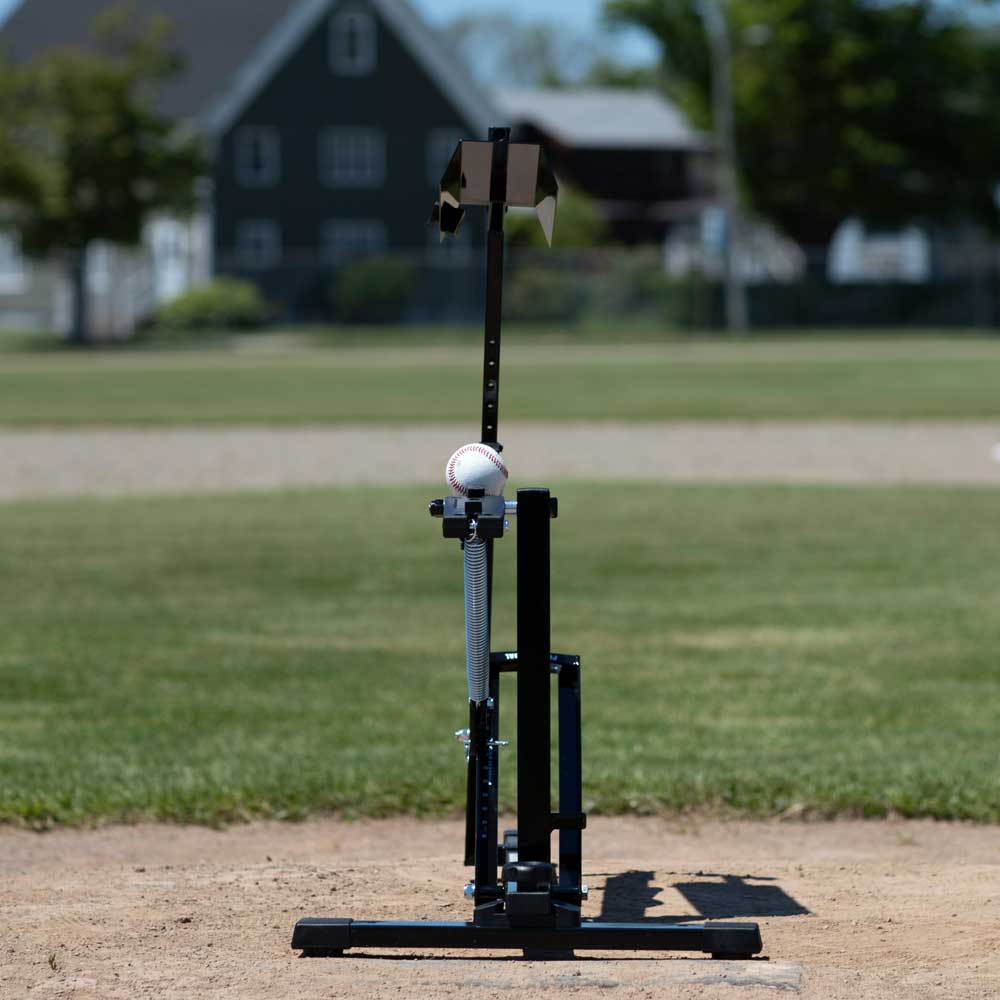
Setting up the pitch target is easy using the release block and adjustable arm. You can switch between a few different pitching trajectories, and it really shines when you set it up for ground balls, fly balls, or line drives.
Because of its flexible trajectories, you can train not just your hitters but your fielders too. That said, since you’re manually feeding one ball at a time, running your entire fielding team through it in one session probably isn’t the best use of your practice time.
My only gripe is that it’s a bit lighter than other pitching machines out there. If you haven’t secured it properly, it can shift slightly after each pitch and drift off target over time. To counteract this, I always pile a few sandbags around the legs and use the included ground stakes to keep it planted.
3. Frame Quality
At first glance, I wouldn’t blame you for thinking this machine might break down after a couple of months. Honestly, I didn’t have much faith in its build quality when I first looked at it either. But after a few years of rough use, I still haven’t found any dents or real signs of damage on mine.
The lightweight steel and aluminum frame of the Black Flame doesn’t really convey how sturdy it actually is. Even with heavy use training players, you should get years of life out of it.
The one part worth keeping an eye on is the spring, since that’s what’s responsible for the pitching speed. But even if the spring wears out or snaps, it’s cheap and easy to replace, so I wouldn’t worry too much about it.
4. Portability
Portability is one of its strongest features and one I appreciate the most. The whole machine weighs around 24 pounds, so if nobody’s around to help, you can carry it out to the field yourself.
I wouldn’t recommend solo-carrying it fully assembled though, since it has several small parts that make it awkward to haul in one piece. Thanks to the lightweight frame, I’ve never had an issue letting my youth players carry it out with me once it’s disassembled.
[affiliatable id=’44422′]
5. Price
The Louisville Slugger Black Flame is one of the best pitching machines out there when it comes to value for money. It has solid overall performance with little to no major issues, and pricing through Louisville Slugger’s own training gear store currently sits right around $200. That’s a solid deal for a machine that holds up as well as this one does, though it’s always worth comparing prices across retailers since they shift from time to time.
The Blue Flame is priced a little lower, and if your budget is extremely tight, that can still be a solid choice. But the bump in speed range and league approval you get by spending a bit more on the Black Flame is worth it in my book.
How to Adjust the Speed on the Louisville Slugger Black Flame Pitching Machine
Adjusting the speed of the Black Flame is easy, but it can be a bit annoying for new users at first. Since it’s a fully manual device (there’s no motor and it never needs batteries or a plug), you adjust speed yourself using the spring. Without a console or control panel to lean on, speed adjustment feels a little finicky the first time around.
Once you get the hang of it, though, it really doesn’t take long or much hassle. The speed is mostly controlled by the spring that connects the power pedal to the throwing arm. You’ll find several small holes on the pedal where you can attach the spring.
The location of the spring on the power pedal dictates the overall pitch speed. You should also get a speed chart in the instruction manual that ships with your purchase. If you want a deeper look at what’s going on mechanically, my guide on how a pitching machine works breaks it down further. Either way, consult the chart to figure out where you want to attach the spring for the speed you’re after.
Another small factor that affects the machine’s speed is the type of ball you use. The Black Flame is a versatile machine that handles a variety of baseballs and softballs, including regulation balls. If you go with lighter or smaller balls, you’ll get a noticeably higher velocity out of it.
You can also adjust the pitching height using the release block on the throwing arm. If you want even more height adjustment options, Louisville Slugger sells an optional throwing arm attachment for the Black Flame. It costs a fair bit extra though, and honestly, most coaches don’t need it.
Does the Louisville Slugger Black Flame Make the Cut?
The Louisville Slugger Black Flame is one of my personal favorites when it comes to pitching machines for little leaguers. It offers fantastic value for the money, and I use it extensively in different hitting and fielding drills. Between pitches, I also get a chance to talk with my players and give them pointers.
Sure, if you’re comparing it to an automatic pitching machine, it’s not going to break any records. But as a manual machine that runs on nothing but an operator’s arm, its performance is hard to beat for the price. If mine ever wore out, I’d buy another one in a heartbeat. Cheers!

With 4 years of Division II experience, a .272 career batting average, .410 on-base percentage, and 7 home runs, I’m now in my fifth season. I’ve played baseball since age 3, alongside future MLB Draft picks, and I aim to pursue a career in baseball professionally, be it playing, coaching, or scouting.